Thursday, January 14, 2010

Santiago and a Side Trip to Little San Francisco

Before we left on this trip, everyone we met raved about the buses in Chile and Argentina. After multiple bus rides all we can say is, really????? Clearly everyone is paid by the hour as it is extremely important that we go as slow as possible and stop for a good 45 minutes at each station, even in a town of 3,000 people. In addition we seem to always get the two seats that had to have been occupied by really messy eaters before us. Not just a few crumbs here and there, I would be surprised if any food actually made it into their mouths. Not that we are complaining, we have been on some bad buses over the past year, but bad usually equals entertaining. These buses can just get frustrating.

We bought a connecting bus ticket in El Bolson, taking us through Bariloche where we would change buses and continue on to Osorno, Chile where we were hoping to catch an overnight bus to Santiago. Our bus left El Bolson 30 minutes late, arriving in Bariloche late as well. We were worried about our connection time, but it turns out there was no need for that. When we went to check on the bus they told us it was an hour and a half late. So we waited….and waited. Turns out the bus was 4 hours late. When it finally showed we drove to the border, waited there for awhile and finally arrived in Osorno at 11:30pm. Luckily we were able to catch the last bus out of town at 11:50, and arrived in Santiago the following day at noon.

Our long travel day continued as we wandered around Santiago for 3 hours with our full packs on trying to find a hostel that had a bed open, turns out they were all full. As we sat on a street bench wondering what to do next a man approached us and told us about a new hostel in an unmarked building right behind us. We figured we had nothing to lose and checked it out. Not sure if it was really a hostel or someone who was just renting out one of their three bedrooms, but we ended up staying. With a place to sleep we were finally able to check out Santiago. We spent a lot of time walking around, touring the plazas, presidential palace and people watching. We also went on some long runs, exploring some of the many parks in the city. After 2 nights in Santiago we decided to head out to the port city of Valparaiso. We had two more return trips scheduled for Santiago and wanted to move on to something a little different.

Valparaiso definitely satisfied our interest in finding something new and different. It is a town of 250,000 people, just 2 hours away from Santiago and some call it “Little San Francisco” due to its physical attributes as well as the port traffic it received prior to the opening of the Panama Canal. I am not sure how much it resembled San Francisco, but we loved it. The city has loads of character. All of the housing is perched on steep hills and cliffs surrounding the port and there are funiculars (part elevator part cable car) that carry people up and down the inclines. The city has multiple cafes, restaurants and bars as well as open air graffiti museums and best of all, a running path directly on the water where the local dogs met us each morning to enjoy our runs with us. Most of the lodging options in town are unique, and ours did not disappoint, with wooden spiral staircases and a trapeze in the middle of the common hangout room. Valparaiso turned out to be a great place to experience some Chilean culture for a few days including really good but affordable Chilean wine!


We are now off to Patagonia, something we have been looking forward to since we started planning this trip. There is a certain sense of solitude and adventure that comes to mind when you hear the word Patagonia. We will update on the journey when we get the chance.

Saturday, January 9, 2010

The Lakes District of Chile and Argentina

There is nothing like camping in the Lakes District of Chile and Argentina to keep you procrastinating on writing a blog post!

We flew into Santiago from Quito on an overnight flight arriving the day after Christmas and caught a local bus to the city center where we booked our next long haul bus south. The airport and bus stations were surprisingly busy for Christmas and we were a little anxious to get south before the New Years crowds arrived on holiday.

We arrived in Valdivia, Chile late afternoon on an overcast day and searched out a hostel to catch up on rest after our long days of travel. Unfortunately, the rains had arrived with us and nixed our camping aspirations. It is rainy season in Chile but the full day long showers we were receiving are not the norm and our afternoon highs were 10 degrees below average! We dug out our rain jackets and long sleeves and opted for a few more days in a cozy hostel in the hopes of dryer and warmer days to come.

Historically Valdivia acted as the seat of German immigration to the region in the 1850s and 60s. Large droves of immigrants arrived during this time and their influence remains very evident today . The architecture of the homes as we entered the district were in stark contrast to what we had seen elsewhere in South America, resembling something out of a northern European countryside picture book. Valdivia today is an active riverside university town with German style taverns and beer halls perched on street corners next to chocolate shops and fondue restaurants. We were able to get in our daily runs along the water and balanced that with a couple of beers from local taverns and the comforts of a westernized supermarket before heading west to the border with Argentina.

No issues at the boarder crossing besides a slow bus driver who must have been getting paid by the hour. Argentina actually recently joined Brazil, Bolivia and Chile in charging Americans a $135 reciprocal fee for entering their country but luckily they are only charging at airports and we skirted this by taking a land crossing. As we crossed the political border we also got our first up close experience with the physical border between the two countries, the stunning Andes Mountains. The road wound up through steep valleys and crossed raging mountain rivers before dumping us out on the shores of Lake Nahuel Huapi and the tourism hot spot of Bariloche. Bariloche is best known as a premier winter ski destination but also lures mass crowds during the summer months (now!), families looking for a week at the lake and rugged outdoorsmen looking to scale the many surrounding peaks. The rains followed us to Bariloche but luckily cleared on our second day and we found our way to a campground a few kilometers from town away from crowds. We set up camp and headed out on a hike up the shores of the lake. Lucky for us, Bariloche has much of the same German influence as Valdivia and we encountered three microbreweries along the shores of our 12 kilometer hike! The following day we broke camp and headed into town for NYE. The town was now completely packed with people but we had prebooked a private room in a hostel instead of doing our usual wandering. We headed out for an evening drink but we were surprised to find that at 8PM nowhere was open. Either the bars don’t celebrate NYE or they all open up late at night. After nearly an hour of searching we found an open pub (not surprising, it was owned by a guy from Chicago) where we were able to get a pint. From there we retired to our hostel with a bottle of champagne and celebrated everything we had experienced in the past year and welcomed in 2010.

The scenery kept getting better the further south we headed so we pushed on to the town of El Bolson, at the Northern tip of the famed Patagonia region. El Bolson is a town of 20,000 inhabitants that actually feels much smaller. The locals pride themselves on their open-minded ‘alternative’ lifestyle and have deemed the town an ‘ecological municipality‘ and a ‘nuclear free zone‘ (not sure what exactly qualifies it as either). The town is situated along a river at the base of jagged mountains tops and spires, the type that have made the scenery in this part of the world so famous. Forest surrounds much of the village while fields producing fresh produce and hops for beer also abound. We searched out a campground on the edge of town and checked in for 4 nights. Our camping neighbors were quite the motley crew. To the left we had a climber and guide from the Yukon Territory and to the right we had a long hair fully bearded climber from the Bavarian Alps. These guys were serious with their gear; expedition tents, ice axes, crampons, basically all that really cool gear you see at the sports store and would like to buy but know you would never legitimately use. They made great company during our stay as we swapped stories and cooked over campfires.

As with many South American towns, one of the main attractions of El Bolson is their weekly outdoor market. El Bolson’s actually occurs three times weekly and starts a little later in the morning (the laid back lifestyle allows for sleeping in). This market is actually quite different from any other we have seen; it is light on livestock and produce but heavy on crafts. Woodcarvers, welders, sculptors, and knitters all sell their goods as well as musicians, chefs and craft brewers. The market is massive, there must have been well over 100 vendors lined up around the lake in the city park. We wandered the aisles, eventually settling on a wood carved cheese board for $3, some craft beer for $2.50 a pint and some gourmet pizza for $1 a slice. The following day we headed out on a hike up the valley rim to an overlook of town and the next day we hired bikes and road out through the hop fields outside of town to a high mountain lake about 15 miles away.

After 4 nights of camping (and two broken tent poles we were luckily able to repair with a trip to the local gas piping store) we shifted to a hostel with wifi to watch the Iowa Bowl game. Accommodations were extremely crowded so we had to sleep in a 6-person dorm but we convinced the staff to let us stay in the lobby until after hours (the game ended at 2AM here!) as we cheered on the Hawkeyes and enjoyed a little slice of back home to compliment our great experiences the days before.

Side Note: If anyone ever makes it to Valdivia, be sure to check out the abnormally large seals on the rivers edge. They must be some sort of freak of nature (actually I think the fisherman at the market feed them too many scraps) because they make the seals at Pier 39 in SF look like Chihuahuas.

Sunday, December 27, 2009

Ecuador - Cuenca, Quilotoa, Quito & The Middle of The Earth

Ecuador was the final stop on our overland swipe across the middle of South America before heading south to Chile. The Peru/Ecuador border was listed as the ‘most corrupt border crossing in South America’ by our guidebook and multiple stories from travelers online had confirmed this statement. We arrived by bus with some nervousness but were processed and granted entry into Ecuador with nothing more than a couple of questions.

From the border we headed north 6 hours to the historic town of Cuenca. We spent 3 nights resting (I was fighting off food poisoning, likely a result of bad water used to make coffee as Colleen was untouched) and wandering narrow cobblestone streets rimmed with colonial mansions and churches built by the colonial Spaniards beginning in the 16th century.

We left Cuenca appropriately rested for our next adventure, the Quilotoa Loop in central Ecuador. The Loop is a series of small Ecuadorian Andean villages connected by dirt roads and hiking trails. The appeal of the route is the opportunity to observe the rural indigenous people going about their traditional daily lives, working with livestock, tending fields and taking their produce to market. Plus the countryside has some amazing views. We caught a local bus from the regional hub of Latacunga and were surprised to find that we were the only foreigners aboard. Our counterparts on the bus would have been right at home in many African countries as they seemed to get enjoyment out of the overcrowded standing room only mode of transportation! About a mile outside of Latacunga we turned off the pavement and onto a bumpy dirt road that would be our entertainment for the next 4 hours as we wound our way around mountains, along steep cliffs and through picturesque valleys.

We arrived at our destination, the small village of Isinlivi and checked into our hostel. The establishment was said to be run by an English speaking Dutch couple but we were greeted at the door by a young local woman who turned out to be the hostel cook. She would be the only person we had interaction with (broken Spanish and hand gestures) during our stay. It turns out there were no other guests for the night and the owners were out of town. It was early afternoon so we headed out on a hike into the hills surrounding the village taking us up hillsides and across meadows before returning for a wonderful 4 course vegetarian meal included with our stay.

We studied some maps and notes from previous travelers the next morning and headed out on a hike to the village of Chugchilan, some 15+ kilometers away across the valley. The terrain was difficult and steep as we wandered down unmaintained paths and crossed log bridges over full streams. Unfortunately, we had a ’helper’ with us along the entire route. The hostel dog (actually more of a puppy) had taken it upon himself to head out of town with us. We discouraged him and chased him away in fear he would not find his way back home but it was to no avail. He was unshakable as he energetically followed us on our day long hike, getting dirtier and increasingly panicky along the way. We felt sorry for the guy but really had no option but to continue on our hike and hope he either would change his mind or we would find a passerby to lead him back to his village.

We arrived in Chugchilan in a late afternoon drizzle and the dog parted with us to introduce himself to some of the local dogs. We checked into a hostel, dried off and found our way to the common room where we huddled around a black stove and spent the evening comparing stories with fellow travelers.

We awoke early the next morning to a hearty breakfast provided by the hostel and hitched a ride on the back of a local pickup heading toward the highlight of the Loop, the Quilotoa Crater. The crater is actually an active volcano that is filled with iridescent blue water. It is absolutely stunning.. Most choose to view the crater from one of the cliffside hotels or by taking a hike down the steep slopes to the shore. Of course this was not enough for our hiking appetite so we decided to take on the full 8 mile hike around the crater rim. Well, we bit off more than we could chew and unfortunately did not realize it until we were on the opposite side of the crater in a dense fog. The rim trail actually takes an exhausting indirect route climbing and falling multiple times up and down the jagged cliffs of the crater. No step of the hike seems to be on solid ground as the brittle rock crumbles into sand with each step. We both swore that we had never had a more difficult day hike in our lives! 5 hours and only 8 miles later (plus detours and multiple slips and falls and a crazed dog that bit Colleen‘s shoe) we found ourselves wandering back onto the main road leading to/from the crater. As we were catching our breath we heard a loud booming horn in the distance which we recognized as a departing bus. Buses only visit the crater a couple times a day so we immediately began a fatigued run blindly in the foggy mist. We reached the bus just as it was pulling away and luckily it was direct back to Latacunga where we had stored our luggage during our 3 days of hiking.

From Latacunga we headed further north to the capital city of Quito to spend Christmas. Upon arriving at the Quito bus station we ran into acquaintances from our hiking who told us that our formal hostel had been informed that their dog was wandering around the village across the valley and that the owners were now actively looking for the dog (this put us a little at ease as by this point we felt as though we were responsible for making a dog homeless). Given the holiday season, we had booked ahead for three nights in Quito and quickly found ourselves at ease in the backpacker friendly ‘new’ part of town. We took day trips to ‘old town’ Quito and explored cathedrals, parks and the country’s colonial past. We climbed rickety steps to the top spire of the famed Basilica del Voto Nacional cathedral for some amazing views(they don’t worry too much about liability is this country) and made a trip to the main market where I sampled some delicious corvina (sea bass) receiving twice as much fish for 1/10 the cost of back home. We also made a side trip an hour north of town to the official site of the Equator where we took some token tourist photos and learned some interesting facts. Who knew that the earth had an ‘equatorial bulge’ that placed the earths surface at the equator a full 11 miles further from the center of the earth than the north and south poles? And who knew that because of this bulge that there are volcanoes in Ecuador that are nearly 2 miles closer to the moon than Mt Everest? Crazy stuff!

Our first two months in South America have been full of amazing experiences. This continent has intriguing and sometimes challenging sites and activities yet the countries maintain a friendliness and flexibility towards travelers allowing for amazing rewards if one puts in the effort. If this is any indication of what we have in store for our last two months in South America (and on the trip), we are in for an enjoyable finale.

Friday, December 25, 2009

Feliz Navidad and Happy New Year!

To everyone at home or wherever you may be, Merry Christmas and Happy New Year! We hope everyone is enjoying time with family and friends and traveling safe. It is hard to believe it is already the end of 2009. It feels like we started on this adventure a short time ago. We are looking forward to seeing everyone in a few months but are extremely excited for the countries and experiences that remain.


We don’t mean to brag, but it is 85 degrees and sunny at the equator. Flying tonight to our next destination: Santiago, Chile.

Thursday, December 17, 2009

On the Trail of Gringos

Peru is the IT place to travel right now. There are people everywhere. Tons of Americans, which we have not seen in such high numbers since we started this trip 10 months ago, as well as the ever present English, Irish, Australian and surprisingly, a massive number of French. Of course everyone comes to see mythical Machu Picchu, but there are tons of other activities to do in Peru, which brings in the crowds. We spent a lot of time discussing where all these people had came from and decided that we might as well ’join the party’. After Cusco we hopped on the aptly named ‘Gringo Trail’ with the masses that move in both directions between Cusco and Lima.

First up, the Nazca Lines. Spread over 500 sq km of land, the Nazca Lines form a network of over 800 lines, 300 geometric figures, and about 70 animal and plant drawings in the Peruvian desert. Now a Unesco World Heritage Site, the lines remain shrouded in mystery. There is no absolute idea of who created them or why, only theories,. To properly see the lines your must view them from overhead by flight in a small, light aircraft. We decided you couldn’t come to Peru and not see the lines, plus who doesn’t want the adventure of a small plane ride, so we immediately added a visit to our itinerary. The town of Nazca is a dry, dirty place, not really where you want to linger around for long,. We arrived by 13 hour overnight bus from Cusco, and immediately hoped in a cab and headed to the tiny airport with a New Zealand girl we had met on our bus. With three of us we hoped to have some bargaining power on the price of flights, and 15 minutes after arriving we where signed up for a 35 minute over flight for an affordable $40/person in a 4-seater plane (Cesna 172) that left immediately. Talk about quick. As the plane took off, I was a bit nervous as I hadn’t been in an aircraft this small since I was a child. It did not help that one of our passenger doors popped open just as we were heading down the runway, but Chad helped calm my nerves. The flight was amazing. I absolutely loved being up in the air in such a tiny plane and it gave me a feeling of freedom that we rarely feel trapped in all the long haul buses on the ground. There is a certain sense of peace up in the air, and it reminded me of my dad. And the lines, well, they were interesting and odd. The lines are truly unique and are unlike anything we have seen on this trip. Most of all, they are simply puzzling. The pilot flew us in tight circles, banking on both sides of the plane so everyone could get a good view and in the process making Chad feel a little nauseous!

With the excitement of the flight over, we caught the next bus 2 hours north to the town of Ica. Ica is famous for one thing, a liquor distilled from wine grapes called Pisco. We decided to stay 5 KM outside Ica in the small town of Huacachina (pop. 200), completely surrounded by sand dunes and sitting on a tiny lagoon. Our guidebook said it was THE place for backpackers to hang out, so we decided to join in on the relaxed atmosphere. So, maybe it was a little too relaxed! Such a small town with literally only a couple of streets and chock full of travelers begins to feel claustrophobic. On our second day we rented sandboards and headed up on our own into the dunes for a little adventure. Neither of us had ever tried sand boarding before but discovered that it was a bit different from our beloved snowboarding and we got a good laugh out of each other falling down the dunes. That same day we decided to get a break from the small town and hired a taxi for the afternoon to take us Pisco tasting in some of the surrounding bodegas (wineries). We visited three bodegas in all, ranging from the oldest winery in South America founded by the Spaniards in 1640 to a small family run bodega which only produces a few thousand cases of wine per year. We sampled some great wine, and some that was so-so. The wine is all stored in centuries old large ceramic jars resembling WWII bombs and we were able to taste directly from the containers. All of the tastings were free so we bought a bottle at the conclusion of each bodega and that with the cost of the taxi only came out to $25 total for the afternoon. If only Napa were that cheap!

We then pointed ourselves further northward on a 4 hour bus to the capital city of Lima. We booked a hostel room in the trendy Miraflores neighborhood on the ocean and spent the next 3 days going on long runs along the cliffs by the ocean and eating at the very impressive westernized local supermarkets.

Relaxed and refreshed we boarded an 18 hour overnight bus northward to the Peruvian surf town of Mancora. Peru has surprisingly impressive beaches in the North accompanied with throngs of local and international tourists and surfers. We checked into a hotel and paid a couple extra dollars to have a oceanside balcony where we had the endless entertainment of the massive ocean waves and energetic surfers. We had planned to do some surfing ourselves but a recent storm in the pacific had brought with it 8-10 ft surf and all surfing lessons were canceled for our days at the beach. We took a rain check (maybe Uruguay?), bought a liter of boxed wine and enjoyed the view from the balcony, concluding our days in Peru.

Sunday, December 13, 2009

Machu Picchu - In Pictures

Our first glimpse at Machu Picchu really wasn’t much. In fact we couldn’t see more than a handful of feet in front of us due to the rain and fog. We hightailed it up trail to a thatched roof hut and huddled inside for the next 2 and a half hours, trying to dry ourselves off, warm ourselves up and hoping all along that the rain would stop, the fog would clear and we would finally see something. Luckily for us, around 9AM, we were rewarded. First the rain stopped, then the sun fought it’s way through the clouds and eventually, what lay before us was this:


And suddenly, all the cold, rain and wind were worth it.

With our new found clarity, we spent the next 7 hours wandering and exploring the amazing Inka ‘lost city’. We had arrived early enough in the day to score one of the coveted 400 spots to climb Wayna Picchu, a set of hilltop ruins with an amazing overall view of the site. It is hard to put the beauty of Machu Picchu in words, we only hope the pictures below can do it some justice.


At the end of the day we hiked back down the mountain to Aguas Calientes, where we took the easy way out and caught the ‘backpacker’ train to a town called Ollantaytambo. From there a shared mini bus brought us the last 2 hours to Cusco where we had started a few short days earlier. Our way of doing Machu Picchu may have been different than the traditional route, but it definitely was an adventure and highlight of Peru.

Friday, December 11, 2009

The Trail Less Traveled

Another day, another border crossing. Lake Titicaca straddles the Bolivian/Peruvian border and we had purchased a bus ticket which would fist take us to the boarder crossing and then to a second bus that would drive us through the night to the city of Cusco, Peru. Upon arriving we were told that the upgraded seat we had purchased (upgraded in the fact that it reclines) was not available and that no refund would be given for the difference in prices we had paid. I ended up exiting the bus to argue with the bus agent while Colleen kept an eye on our seats and bags and received a small refund but had to cut my losses as the bus was beginning to pull away without me. We crossed the border with no hassles in a torrential downpour but were told that the bus company now needed additional money for the second bus, a bus we had already paid in full, due to a ‘strike’ among the bus drivers. Of course this was a load of crap and a scam but what choice do you have, either pay up or get off the bus in the middle of nowhere at midnight in a thunderstorm.

We arrived prior to sunrise in Cusco and waited for some daylight before sharing a cab with 2 German girls to a local hostel. Cusco is a beautiful town. It is famously known to most travelers as the staging point for trips to the ruins of Machu Picchu but it is also a sight in itself. It is said to be the longest continually inhabited city (and the head of the Inka Empire) in the Americas and offers wide plazas to compliment narrow cobblestone streets, centuries old churches and the backpacker comforts of cheap markets and corner pubs.

We had a couple main tasks at hand in Cusco. First, we wanted to pick up sleeping bags and a tent to do some camping over the last couple months of the trip, namely in Chile and Argentina. We had read Chile is quite pricey and limited on selection when it comes to equipment so we decided with all the tour operators in Cusco that we should take advantage of the selection. We ended up picking up two new North Face sleeping bags (absolutely fake but the agent insisted they were real) along with a high end used 2 person mountaineering tent at very respectable prices.

The second task at hand, of course, was to search out when/where/how we could reach Manchu Picchu. There are three main options when it comes to reaching this wonder of the world. The most well known option is to hike the historical Inka trail, 33 kilometers over 4 days at a staggering cost of $430 per person all inclusive. Option 2 is to take one of the available ‘side trails’ with a tour company and guide and pay around $250 for the experience. The third option is to go at it alone without a guide or company. For this final option, you must decide on which ‘side trail’ you wish to trek as the famous ‘Inka Trail’ has hiker quotas and permits required. Given the trails are well marked, our respectable experience trekking and finding our own way numerous times on this trip, we decided to go at it alone. Why would we pay several hundred dollars each just to have a guide show us to the nearest restaurant or hotel and point us in the general direction of the trail?

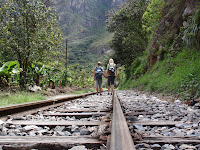
We settled on what is known as the ‘back door’ to Machu Picchu. The route is not highly advertised or mentioned in guidebooks but is a well known path for tour operators who sell the route to travelers on a tighter budget. We headed out on a 7-hour early morning bus to essentially circumnavigate the mountain range thus reaching the start of the ‘backdoor’ route. We crossed mountain passes nearing 15,000 ft and arrived at the dusty town of Santa Maria from where we caught an hour long taxi with a bunch of school kids using the taxi as a bus service to the village of Santa Teresa and our accommodation for the night. We awoke early the next morning, grabbed some local cheese empanadas to-go for breakfast and began our hike. The first leg of the hike had us descending down a cliff out of the village and across a small suspension bridge to a dirt path across the valley. From there is was a 2 hour hike following the river until we reached a hydroelectric damn. To the side of the hydroelectric damn we found the set of railroad tracks we were looking for and knew we were on the right track. We then followed the railroad for about three hours, twisting and turning our way up canyons, crisscrossing bridges and walking through multiple tunnels.

After a total of 5 hours and just over 20 kilometers of hiking, the village of Aguas Calientes came into sight around a bend,. We had spent $9 each on public transit to reach our destination and enjoyed the adventure of a lightly used path. The small community is only accessible by hiking trail or railroad and acts as the launching point for day treks to/from Machu Picchu. We quickly found accommodation for the evening in one of the numerous guesthouses and headed to the market for some much needed food.

Machu Picchu is perched on a mountaintop high above Aguas Calientes and is accessible either by a costly minibus or by way of a steep 6 kilometer hiking trail. Of course we opted for the hiking trail and found ourselves up before dawn the following day and hitting the trail with our headlamps. The trail was quite steep and midway up the mountain a storm moved in and a massive downpour began. Now we were wet, cold and could not see through the dense clouds how close we were to our destination. We trudged on upward through switchback after switchback and just as daylight was beginning to show we reached the ticket counter but were told Machu Picchu did not open for another 30 minutes. So we waited exhausted, soaked and shaking as the first busload of fresh, dry and cheery tourists appeared up the road. We must have been quite the site to them huddled in our wet clothes munching on some day old bread! Finally, the gates opened and we squished through the fog and into Machu Picchu…
SEO Services